
The Korean saying “that’s just my palja (fate)” is familiar to everyone, yet few people actually know what those eight characters are.
Saju palja (四柱八字), literally “four pillars, eight characters,” is a record of the sky’s energy at the moment you were born, written in eight characters. Your birth year, month, day, and hour become four pillars (saju), and each pillar carries two characters, giving eight characters in total (palja). Reading your saju means interpreting these eight characters to answer, “What kind of energy was I born with, and what season of life am I passing through now?” The key point: it is interpretation, not prophecy.
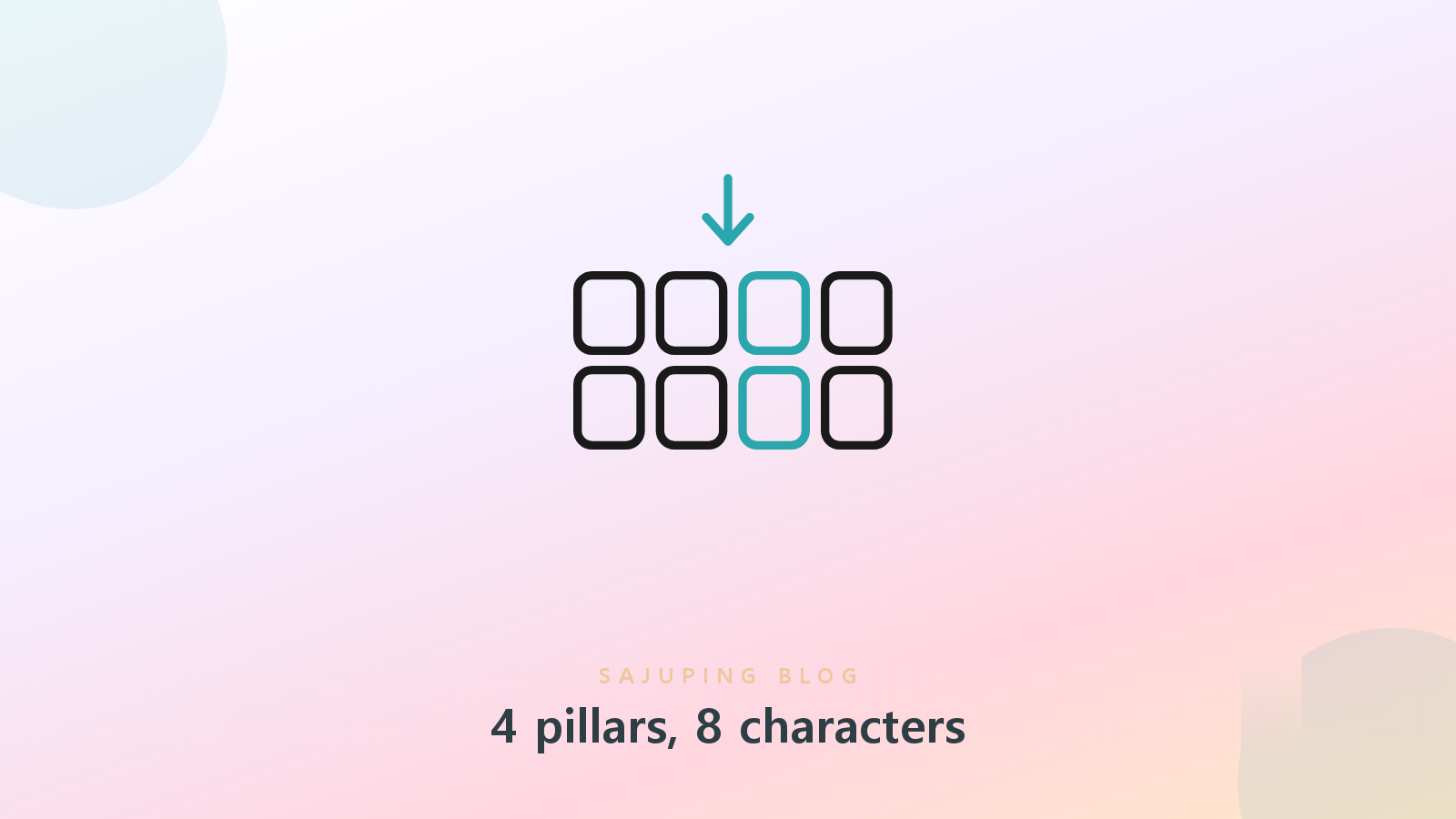
What is written in the eight characters
Each of the four pillars holds a different layer of time.
- The two characters of your birth year: this is where the familiar zodiac animal sign comes from. It carries the energy of your generation and roots.
- The two characters of your birth month: the energy of the season. It sets the temperature and backdrop of the whole chart.
- The two characters of your birth day: the center of the chart. The upper character (the day master) is “you,” and the lower character (the day branch) is the seat you sit on.
- The two characters of your birth hour: the energy of the time of day. This is where the later half of life and your inner direction are read.
This is where the great principle of modern saju comes from: every interpretation unfolds around the day master, around “you.” Centering the person born on that day, rather than the birth-year zodiac animal, is the method established about 1,000 years ago as Ziping myeongni, the classical school, and it is the standard used today in every saju app and fortune-telling house. This is why saju is far more personal than zodiac-animal horoscopes.
How a saju reading works: 4 steps for beginners
Step 1: Cast the eight characters. Enter your birth date and time into a manseryeok (the saju calendar) and they appear automatically. This layout is called your myeongsik, or natal chart.
Step 2: Find your day master. It is the first character of your birth day, the protagonist of your chart. It is one of ten: Gap, Eul, Byeong, Jeong, Mu, Gi, Gyeong, Sin, Im, or Gye.
Step 3: Look at the balance of the five elements. Each of the eight characters belongs to one of five energies: wood, fire, earth, metal, or water. Which energies are abundant or missing sketches the outline of your tendencies and patterns.
Step 4: Layer on the current luck. Over your innate structure (the natal chart) flow the 10-year major luck cycles (daeun) and the yearly luck (seun). When someone says “here’s how your year looks,” they are reading this overlap.

Good to know before you get a reading
Saju is not an answer sheet that reveals a fixed future. Just as people born with the same chart live different lives, what saju shows is a map of temperament and timing, not a destination.
But a map is genuinely useful. If you know what terrain (temperament) you stand on and whether you are on an uphill or downhill stretch (timing), the same effort carries you farther. Recurring relationship patterns, that one unusually hard year, the stretch when everything strangely clicked. Saju is a tool that gives those things a language.
Frequently Asked Questions (FAQ)
Q. Is saju different from divination? Yes. Divination reads “the chance of the moment you draw,” while saju reads “the structure of the moment you were born.” That is why saju gives the same eight characters no matter when you look; there is no redraw. Only the depth of interpretation changes.
Q. Can I still get a reading without knowing my birth time? You can. Without the hour you read six characters instead of eight, but the day master (the center of the chart) and the elemental balance are still perfectly readable. Knowing the hour simply raises the resolution.
Q. What if my saju turns out bad? In the Ziping myeongni view, there is no such thing as a “bad saju.” In every structure, the challenge is the flip side of a strength. A good reading does not scare you; it teaches you the user’s manual for your own structure.
Saju palja is not something difficult or scary; it is an old language for understanding yourself. Starting with just one of the eight characters (knowing what your day master is) is more than enough.
You can check your eight characters and day master in under a minute on Sajuping (sajuping.ai), the manseryeok-based AI saju consultation app. In the next post, we’ll sort out the five energies that move the eight characters: yin-yang and the five elements.