
Listen to a saju (Korean four pillars) reading and phrases like “your fire is strong” or “you lack water” keep coming up. The root of all that language is yin-yang and the five elements.
Yin-yang and the five elements is an ancient East Asian system for reading all the energy in the world through two polarities (yin and yang) and five qualities (the five elements). All eight characters of your saju sit on this framework. Wood, fire, earth, metal, water, which energies are abundant or scarce in your chart becomes the outline of your tendencies, and it is also the lens for reading the texture of a period, as in “this is a fire-energy year.” It sounds difficult, but think in seasons and it clicks in five minutes.
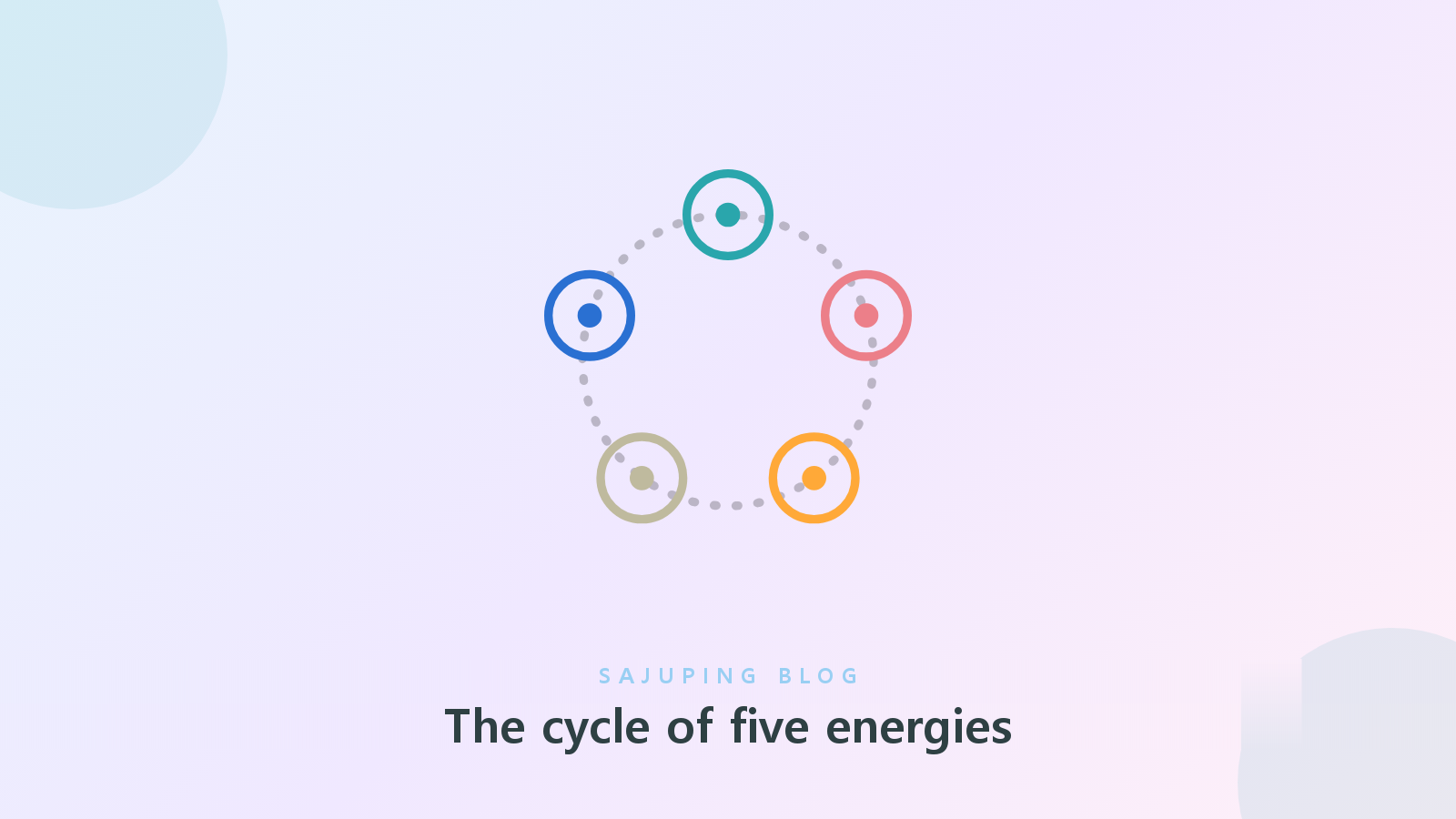
The five energies, understood as seasons
The five elements are not abstractions, they came from the rhythm of nature.
- Wood, the energy of spring. The force that stretches out and begins. People with strong wood excel at growth, planning, and new ventures.
- Fire, the energy of summer. The force that blazes and expresses. With strong fire, passion and expressiveness lead the way.
- Earth, the energy of the transitional seasons. The force that holds the center and connects. Strong earth makes a person of trust and mediation.
- Metal, the energy of autumn. The force that harvests, cuts, and organizes. Strong metal brings clear decisiveness and firm principles.
- Water, the energy of winter. The force that gathers, flows, and stores. Strong water runs deep in thought and insight.
Yin and yang add polarity to this. Just as a towering pine (yang) differs from a climbing vine (yin) though both are wood, each of the five energies divides into yin and yang, making ten distinct textures. These are the ten heavenly stems we will cover in the next post.
Generating and controlling: not good vs. bad, but flow and restraint
The generating (sangsaeng) and controlling (sanggeuk) cycles that always come up in five-element talk are relationships between the energies.
Generating is the cycle of giving life. Wood feeds fire (wood generates fire), fire becomes ash and makes earth (fire generates earth), earth yields metal (earth generates metal), water condenses on metal (metal generates water), and water grows wood (water generates wood).
Controlling is the relationship of restraint. Wood breaks through earth, earth dams water, water quenches fire, fire melts metal, and metal carves wood.
Let’s clear up a common misunderstanding here. Controlling is not bad. Just as metal must carve wood to turn it into timber, the right restraint makes energy useful. When a reading says one element “controls” another, it is not a reason to panic, it is a signal to look at which restraint is at work.
How to read the elemental balance of your chart
Cast your eight characters in a manseryeok (the saju calendar) and the distribution of the five energies becomes visible. Reading it is simple.
Abundant energy is your default setting. Three or more fire characters means expression and speed are your default mode. It is a strength, and overheating becomes your homework.
A missing energy is not a deficiency but a direction for growth. Having no water does not mean you lack wisdom; it means pausing and storing are things you will need to learn deliberately.
Overlay the energy of the period, and it becomes your fortune. If 2026 is Byeong-o, a year thick with fire energy, a fire-heavy person and a water-heavy person will pass through the same year in completely different ways. This calculation is the skeleton of every “here’s how your year looks” reading.
Frequently Asked Questions (FAQ)
Q. Can a missing element be filled? Tradition says to supplement it with colors, directions, or names, but the practical supplement is behavior. If you lack water, build habits of journaling and resting; if you lack metal, build routines around deadlines and tidying up. Energy is filled by habits more than by objects.
Q. Do the five elements determine personality? They do not. Your elemental distribution is an innate tendency, and environment and choices stack on top of it. The same fire energy becomes a stage for one person and a short temper for another. Saju shows the direction; how it gets used is up to you.
Q. How do I find out which elements are abundant in my chart? Enter your birth date and time into a manseryeok app and your eight characters and elemental distribution appear right away. On Sajuping, you can go beyond checking the distribution and continue in conversation, asking how to actually put your structure to good use.
Yin-yang and the five elements are not formulas to memorize but the language of the seasons. Someone who begins like spring, someone who organizes like autumn, just knowing which season’s energy you were born with starts to unlock half of your saju.
You can check your elemental distribution on Sajuping (sajuping.ai), the manseryeok-based AI saju consultation app. In the next post, we’ll sort out how these energies become actual characters: the heavenly stems and earthly branches.