
The spouse palace refers to the day branch (日支), the earthly-branch seat beneath the day you were born, one of the eight characters in a saju chart. The method of reading the chart’s four seats as rooms that hold areas of life and the people in it is called palace theory (宮位論).
Eight characters, four seats
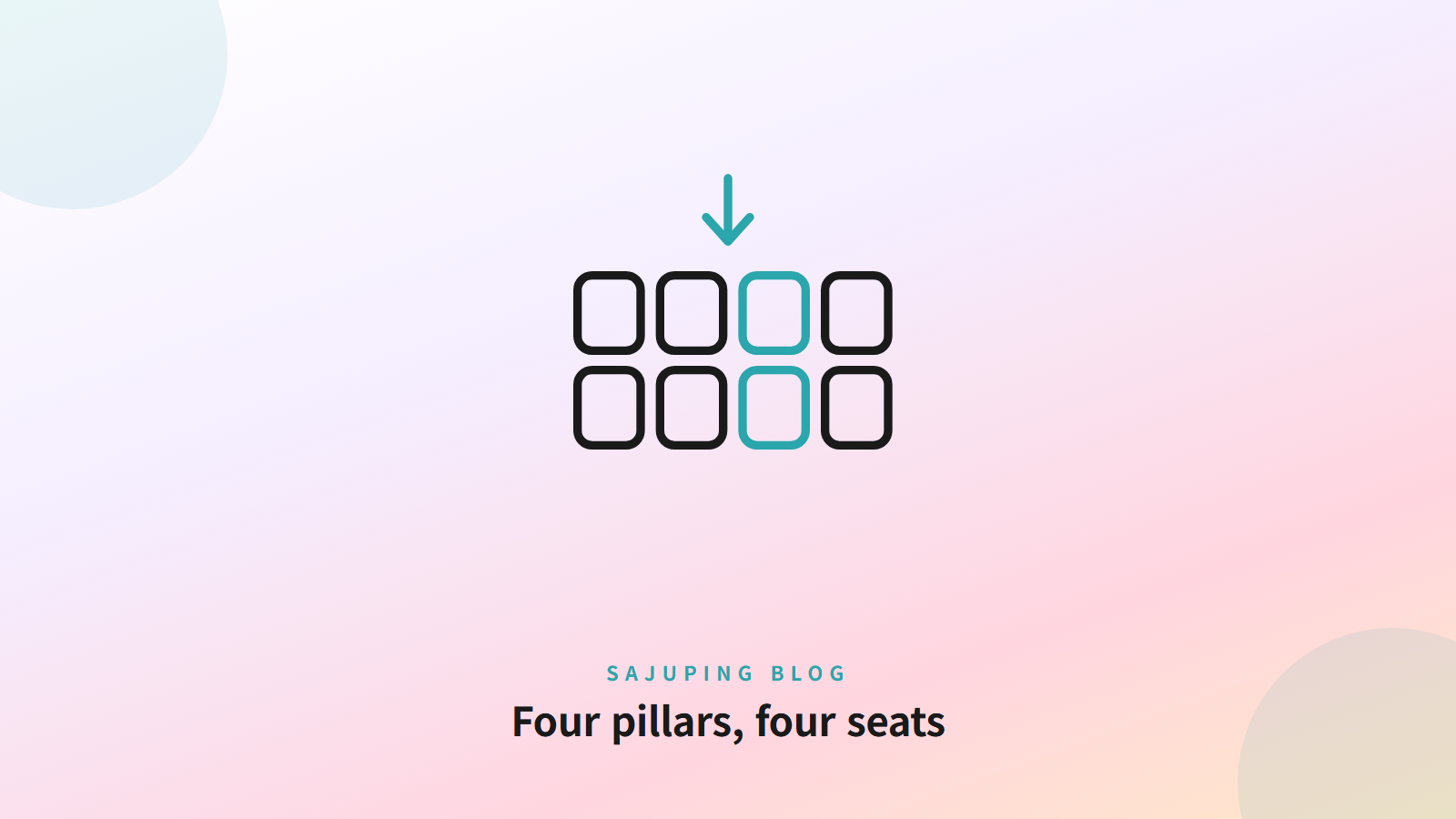
When you draw up a manseryeok chart, eight characters stand in four pillars. The upper four (heavenly stems) are the energy that shows outwardly; the lower four (earthly branches) are the ground of life, the seats. Each of the four pillars (year, month, day, hour) holds one branch below, and these four seats are not mere boxes for characters but four rooms holding areas of life and people. The year branch holds ancestors and roots; the month branch, parents and society; the day branch, spouse and self; the hour branch, children and later life.
The same character reads differently depending on the seat. The same Dohwa energy, for instance, in the year branch reads as early popularity and in the day branch as the grain of a spouse connection. A wealth star in the month branch reads as money earned in society; in the hour branch, as wealth in later life. The meaning of the character is the same, but which room it is placed in changes the story.
The seats one by one — from root to fruit
Placed in order of time, the four seats form the picture of one life running from root to fruit.
- Year branch (年支) — the seat of ancestors, roots, and childhood. It shows the soil you started from.
- Month branch (月支) — the seat of parents, siblings, and society, and the most powerful of the eight characters. Your social stage and the grain of your profession live here. It is also the seat that sets the temperature of the whole chart.
- Day branch (日支) — the seat of the spouse and the ground you stand on every day. Your closest person and your private life are here. Because it reads marriage and home, it is called the spouse palace.
- Hour branch (時支) — the seat of children, later life, and fruit; it shows the landscape of the second half and what you leave behind. Your bond with children and your environment in old age are held here.
In the same chart, the month branch’s story is often louder when you are young, and the day branch’s story after marriage.
How is the state of a seat read?
Each seat is read on two counts. First, which of the ten gods the character in that seat is for your day master: is there an energy in the spouse seat that fills you, or one you have to carry? Second, whether the seat forms a harmony with neighboring characters or is shaken by a clash. Harmony reads as that area being stably bound; clash as frequent change and reorganization. Either way it is not a verdict of good or bad but something closer to a user manual for that area.
For example, a resource star in the day branch reads as receiving emotional support from a spouse; a wealth star there reads as building a practical foundation together. A clash between month and day branches is a grain in which social life and home pull against each other in recurring periods; a harmony between day and hour branches binds the spouse and children areas in one direction.
How to read common situations
“I read that my spouse palace is shaken.” Usually this means the day branch meets a clash, or the year’s energy is shaking it. It does not mean the relationship ends; it means the spouse area has a grain of frequent change.
“What’s the difference between ‘the month branch is good’ and ‘the day branch is good’?” The month branch is the state of your social stage; the day branch, the state of your private sphere. A stable month branch with a shaken day branch is a grain where work goes smoothly but home holds the task; the reverse is a grain where you collide in society and home becomes the place of recovery.
“Same day branch as someone else, but a different reading.” Even with the same character in the palace, a different day master changes which of the ten gods that character is for you. What is a wealth star for one person is an authority star for another — the same room with a different guest sitting in it.
Frequently asked questions
Q. If my spouse palace is bad, will I never marry? That reading is a misuse of palace theory. The state of the palace shows the grain of a relationship, not its outcome. If the structure has turbulence, read it as meaning the effort to know each other becomes the relationship’s seat belt. Many couples with a clash in the day branch stay together for decades by respecting each other’s space and time.
Q. What does it mean that the month branch is the most important? The month branch holds the season you were born in, so it governs the temperature and the balance of forces in the whole chart. That makes it the starting point of interpretation itself, not just of career and social luck. With the same set of characters, whether you were born in spring or winter changes which energy gains strength, and the month branch is the basis for that judgment.
Q. How do you read the same character appearing in several seats? The same character in several seats means that energy’s influence repeats across several areas of life. The overlap makes the grain more pronounced. If the year and day branches hold the same character, for instance, a pattern learned in the childhood environment reappears in the marriage relationship, so reading the seats in connection makes the story clearer.
In closing
Reading a chart only for the fortune of its characters is reading half of it. You have to see which room each character sits in before it becomes your story. This palace framework is the theoretical base for reading topics like spouse fortune and children’s luck, so the upcoming post “Is There Such a Thing as Spouse Fortune? What the Day Branch Tells You” is worth reading alongside this one.
If you want to know which character sits in your day branch, you can check the four seats of your chart in Sajuping (sajuping.ai), an AI saju companion built on manseryeok calculation.